
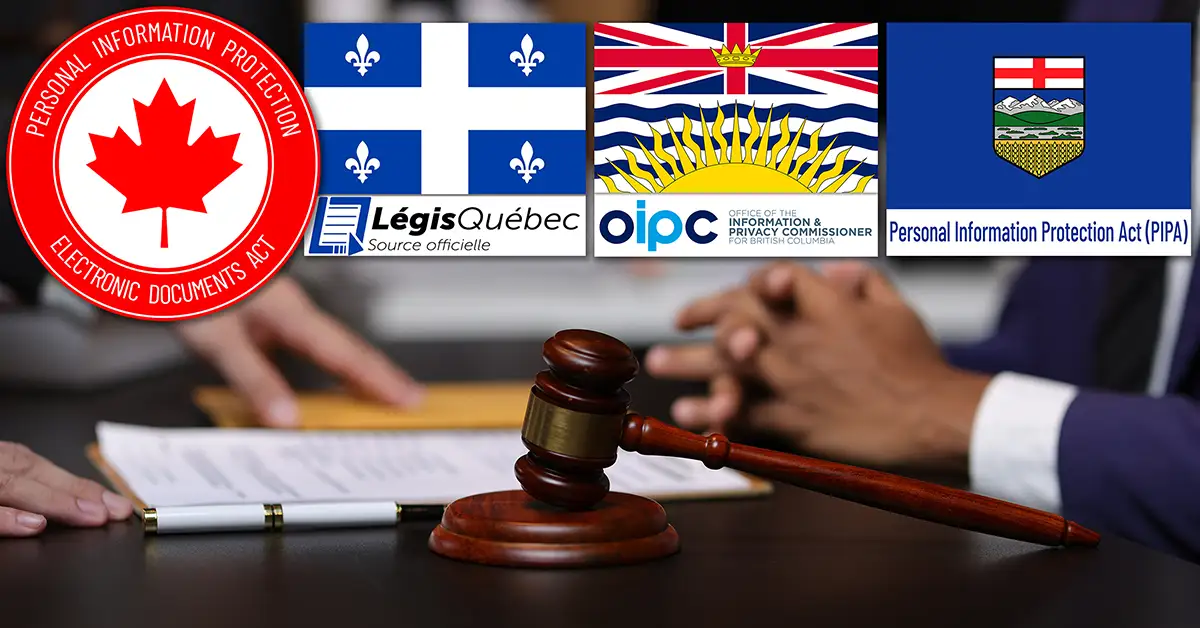
Legal Pages – for 🇨🇦 Canadian Websites
Disclaimer: Before reading any further, please understand that I am not a lawyer or an officer of the law. The information in this document is provided solely as general guidance from an experienced web developer, and not as legal advice. If you have any questions about your specific situation, please refer to the resources linked herein, or consult a qualified legal professional in your area.
Hopefully, you found this article before discovering your website was getting no traffic and not being listed in search engines or directories.
Your website’s presentation may be outstanding, the content fresh and original, and each page a masterpiece of grammatical workmanship – but it’s been weeks or even months, and you haven’t received a single inquiry; – even your friends and family are starting to wonder why they can’t find your web site on line.
Compliance – Your Legal Requirements
When a crawler searches the web in search for fresh content, and it comes across a link to your website; several checks are made:
- If it’s a known web page, the link is added to a link count for evaluating popularity.
- If it’s a new link, it’s scrubbed to determine it’s worthiness for inclusion.
There are many checks done to determine the integrity of a website (covered in SEO), but the single most important check is "Is it compliant?".
To be compliant, a website must meet the legal requirements for it’s target audience and geographical region.
If it doesn’t, the crawler could (and likely will) ignore the link and move on.
Legal Compliance is the topic of this article, and I’m not focusing on minimum requirements to meet minimal standards. I’m trying to impress upon you that a strong legal foundation will protect you down the road.
Note: Failure to include readily visible legal policies on your website may result in search engine rejection.
The Legal Landscape in Canada
Canada’s approach to on line privacy and data protection differs from the United States or the European Union.
While the EU enforces strict GDPR compliance (complete with those frustrating cookie-consent pop-ups), Canada takes a more balanced approach.
Our main federal law is PIPEDA — the Personal Information Protection and Electronic Documents Act.
It regulates how private-sector organizations collect, use, and disclose personal information in normal operations.
Some provinces — British Columbia, Alberta, and Quebec — have their own privacy laws that mirror PIPEDA closely.
- British Columbia – https://www.bclaws.gov.bc.ca/civix/document/id/complete/statreg/00_03063_01
- Alberta (PIPA) – https://oipc.ab.ca/legislation/pipa/
- Quebec – https://www.legisquebec.gouv.qc.ca/en/document/cs/P-39.1
For everyone else, PIPEDA applies directly.
Even if you run a small website or a hobby project, if you collect any personal data (like names, emails, or analytics), you should clearly explain your purpose and how the data is managed.
Legal Docs – An Overview
Before we get into the details, here’s a short list of the most often used legal documents and enough information about them to know whether or not they apply to your website.
| Document | Required? | Purpose | Canadian Notes |
|---|---|---|---|
| 1. Privacy Policy | Highly recommended | Explains how you collect, use, and store data. | Required under PIPEDA for most commercial sites. Simple, clear language is key. |
| 2. Cookie Policy | Optional | Lists the cookies your site uses. | Canada does not require pop-ups. A note in your Privacy Policy or footer is sufficient. |
| 3. Terms of Service | Recommended | Defines your relationship with visitors. | Protects against misuse and outlines ownership of content. |
| 4. Disclaimer | Smart | States that content is informational only. | Especially useful for blogs, advice, or product reviews. |
| 5. Refund / Return Policy | For sellers | Outlines refund or cancellation conditions. | Transparency reduces disputes. Provincial consumer laws still apply. |
| 6. Accessibility Statement | Optional | Shows your commitment to digital inclusion. | Required for federal organizations, encouraged for everyone else. |
1. Privacy Policy – Why a Privacy Policy Is Required in Canada
Under Canada’s Personal Information Protection and Electronic Documents Act (PIPEDA), any organization that collects, uses, or discloses personal information in the course of commercial activity must disclose what it collects and why.
That includes:
- Contact forms
- Newsletter sign-ups
- Analytics tracking
- E-commerce checkouts
- Comment systems
Even if you only collect a name and email address, that qualifies as “personal information.”
PIPEDA does no’t require a specific format, but it does require clarity — meaning your Privacy Policy should be written in plain language, not legalese.
A good Privacy Policy explains:
- What information you collect (e.g., name, email, IP address)
- How it’s collected (forms, cookies, analytics tools)
- Why it’s collected (communication, security, analytics)
- How it’s stored and protected
- Who it’s shared with (e.g., payment processors, analytics providers)
- How users can contact you or request deletion
In short, it tells visitors:
“We take your data seriously and use it responsibly.”
AI Generation
Although there are dozens of websites offering advice and services for generating privacy policies and other legal documents, few are as current, willing to help, and free to use as Chatting. I’m not saying Chatting is the last word on privacy policies or in any way a substitution for a lawyer, but I am saying you will be much closer to the finish line when you start with a Chatting generated framework.
References
2. Cookie Policy — Annoying but Necessary
You’be seen those pop-ups: “We use cookies. Click Accept.”
They exist because of European privacy regulations (GDPR and e Privacy Directive), which require explicit consent before storing cookies.
In Canada, this sin’t a legal requirement — at least not yet. But it’s still best practice, especially if:
- Your site receives international traffic.
- You use analytics or advertising networks.
- You want to show that your site respects global standards.
Most Canadian websites take a balanced approach:
- They explain what cookies do.
- They allow visitors to opt out or block cookies via browser settings.
- They avoid intrusive pop-ups unless targeting EU audiences.
Your Cookie Policy should explain:
- What cookies are used for.
- Whether they track analytics, preferences, or advertising.
- How visitors can control them.
Canada’s Anti-Spam Legislation (CASL) does regulate tracking without consent if it’s intrusive or involves third parties. You can inform users without annoying them — a simple footer notice or mention in your privacy policy is enough.
In essence, it’s about transparency, not bureaucracy.
AI Generation:
Again there are plenty of free and paid services that may help you with your cookie policy, but AI can save you time. As with all AI generated documents, they are intended as editorial examples only and not as legal documents. They must be edited and validated to ensure local compliance.
3. Terms of Use — Your Rulebook
Your Terms of Use (aka Terms of Service), defines how your website may be used and what’s off-limits.
They’re not required by law, but they’re a powerful defensive document. Courts respect well-drafted Tod if they’re visible and accessible.
A well-written Terms of Use can:
- Protect your intellectual property (images, text, code).
- Outline acceptable behavior (no spam, no harassment).
- Limit your liability for errors or outages.
- Establish the governing law and dispute resolution (e.g., British Columbia).
Think of it as a mutual understanding:
You provide a service; visitors agree to use it respectfully.
Your Terms of Use Policy should be clearly linked from your footer, not burred.
4. Disclaimer — A Shield for Writers and Educators
This very page is a perfect example of where a website should have a disclaimer. I am offering advice outside my field of expertise or authority, where if someone follows my advice with negative consequences (financial or otherwise), they may blame me for the result. A few especially troublesome areas are financial, legal, and technical topics where the author may not hold a degree or be certified.
The safest way to protect yourself from such cases is to specifically state in a readable area (preferably not fine print) that you am not an accountant or lawyer and that the material is for informational purposes only and not provided as professional advice. A further statement suggesting the reader consult their local authorities for further advice and guidance should follow, and together should cover most cases.
A simple example:
“The information on this website is provided for general informational purposes only and should not be taken as professional advice. Always consult a qualified professional before making decisions based on this information.”
Adding that one paragraph can save you from potential headaches later.
5. Refund / Return Policy
A refund / return policy serves as a comprehensive document describing the process of returning item(s) and obtaining refunds for purchased goods or services. These policies typically cover:
- Requirements and conditions regarding time and repackaging
- Product or category specific inclusions or exclusions
- Costs, and who pays for return shipment and any restocking fees
- What form any reimbursement will take (e.g. store credit, repayment to payment card)
- Specific instructions on Return Authorization Numbers or approval procedures
These policies apply only to websites providing paid goods and/or services. This may be an Online store, clubs and memberships, subscriptions, or financial services.
Canadian Legal Context:
Although no federal laws regulate return or refund policies, there are consumer protection laws at the provincial level that apply as well as obligations by the credit card companies and payment gateways that sellers using their payment services must abide by if selling goods or services in Canada.
Transparency protects you — unclear refund policies often lead to disputes.
6. Accessibility and Exclusivity – Optional, but Wise
Canada is steadily moving toward stronger digital accessibility standards.
The Accessible Canada Act (ACA) and provincial legislation like Ontario’s AODA encourage websites to follow WCAG 2.1 AA guidelines.
Including a short Accessibility Statement shows that your organization values inclusivity.
It can be as simple as:
“We are committed to providing accessible web experiences for all visitors. If you encounter any barriers, please contact us so we can make improvements.”
This small gesture sends a powerful message.